

How Much Solar Power Does the Average Home Need?
Deciding how much solar power a home needs is practical, not mystical. The right system balances your current electricity use, local sunlight, and whether you want full backup or just bill reduction.
This guide walks you through the real steps—measure, calculate, choose components, and plan installation—so you can estimate system size with confidence and avoid overspending.
Start by measuring real energy use
Begin with a 12-month view if possible. Look at utility bills for monthly kilowatt-hours (kWh). If you don’t have a full year, use recent months and adjust for seasonal variance. For day-to-day accuracy, a dedicated home energy monitor can show circuit-level usage and help you spot big loads (HVAC, water heater, EV charger).
Typical household consumption and a simple sizing rule
The U.S. median household uses roughly 900–1200 kWh per month (about 30–40 kWh/day). To estimate panel capacity needed to cover that energy, use this quick formula:
- Daily kWh ÷ average peak sun hours = required system kW
Example: 30 kWh/day ÷ 5 peak sun hours = 6 kW system. That’s the DC nameplate rating of panels you’d need to produce ~30 kWh before losses.
Choosing panels: watts, efficiency, and real output
Panel watt rating tells you the output in ideal conditions. For real-world planning, factor temperature, tilt, shading, and inverter losses. Browse actual solar panels to compare wattage and efficiency. If you want portable or expandable options for testing or small loads, a portable solar panel kit can be useful for trials or RV/home supplemental power.
Estimate system losses and usable energy
Expect system losses of about 10–20% from DC panel output to usable AC energy. Loss sources include inverter efficiency, temperature, wiring, shading, and mismatches. Use conservative assumptions: if panels produce 6 kW and you expect 15% losses, usable energy equals 6 kW × peak sun hours × 0.85.
Essential system components and sizing considerations
A typical residential solar system includes panels plus these key components. Each affects system sizing and performance:
- Inverters — Convert DC to AC. Size the inverter to handle your peak household load or choose oversized panels with proper inverter clipping considerations.
- Charge controllers — Required for battery-based systems; MPPT controllers improve panel-to-battery efficiency for off-grid or hybrid setups.
- Solar batteries — If you plan energy storage for backup or time-shifting, size battery capacity in kWh to cover desired outage or night usage.
- Installation accessories — Mounting racks, connectors, and wiring affect performance, safety, and long-term maintenance.
Grid-tied vs off-grid vs hybrid: how this changes required size
Grid-tied systems sized to offset bills can be smaller and rely on the grid for nighttime and cloudy days. Off-grid systems must be large enough to cover worst-case multi-day outages and include battery storage—often significantly larger than a bill-offset system.
If you want reliable backup without full off-grid sizing, consider using solar generators or a hybrid inverter-battery setup to power critical loads only (refrigerator, communications, a few lights) rather than the whole house.
Practical examples: sizing for common households
Here are ballpark examples using average peak sun hours = 4.5–5.5 (adjust to your location):
- Energy-savvy 1–2 person household (15 kWh/day): 15 ÷ 5 = 3 kW system (roughly 8–10 panels at 300–370W).
- Average family (30 kWh/day): 30 ÷ 5 = 6 kW system (about 16–20 panels).
- Larger home with EV and electric heat (60 kWh/day): 60 ÷ 5 = 12 kW system (30–40 panels), plus significant battery capacity if backup desired.
These examples assume partial system losses and typical tilt; adjust upward for heavy shading, high temperatures, or future load growth (EV, heat pump).
Costs, incentives and payback considerations
Cost per watt varies by market, panel choice, and installation complexity. A smaller system focused on critical loads can lower upfront costs and still improve resilience. Factor in local incentives, net metering rules, and expected electricity price inflation when estimating payback. A home energy monitor and careful load-shifting strategies will improve ROI by showing opportunities to reduce consumption and maximize self-consumption of solar production.
Installation and maintenance basics
Quality installation and components matter. Use proper mounting hardware, gauge wiring correctly, and follow manufacturer specs for warranties. For DIY or professional installs, having the right parts on hand—rails, clamps, connectors—simplifies the job. Shop compatible installation accessories and follow best practices for grounding and weatherproofing.
Small checklist before you size and buy
- Collect 12 months of utility kWh consumption or use a monitor for 1–3 months.
- Determine average peak sun hours for your roof orientation and shading.
- Decide goals: bill offset, partial backup, or full off-grid capability.
- Choose panel wattage and calculate DC system size (kW) using the kWh formula.
- Select inverter type and size to match panel array and load profile (inverters).
- For battery systems, size usable kWh capacity and add solar batteries appropriately.
- Add 10–20% for system losses and a margin for future loads.
FAQ
- Q: How do I estimate peak sun hours for my location?
A: Use solar maps or local PV production estimates; your energy monitor plus a short test array can validate local performance. - Q: Will panels produce their rated wattage year-round?
A: No—nameplate is ideal lab output. Real output varies with tilt, temperature, and shading; expect 75–90% of ideal depending on conditions. - Q: How big should my battery be for overnight backup?
A: Decide which loads you need overnight and multiply their combined wattage by hours needed to get kWh; size battery for usable kWh, accounting for depth-of-discharge limits. - Q: Can I add panels later if my needs grow?
A: Yes, many systems are designed to be expanded. If you plan expansion, size your inverter and roof layout with that future capacity in mind. Portable or modular options like a portable solar panel kit let you test additions. - Q: Do I always need a professional installer?
A: Electrical work and permitting often require licensed professionals. Small, off-grid experiments can be DIY, but for rooftop grid-tied systems a certified installer ensures safety, code compliance, and warranty validity.
Conclusion — practical takeaway
Start with measured energy use, convert daily kWh into required kW using local peak sun hours, and add margin for losses and future growth. Choose components that match your goals—bill reduction, backup, or full independence—and invest in monitoring to fine-tune system size. For modular testing or staged builds, portable panels and quality installation accessories make expansion straightforward.
If you want to explore components while planning your system, check product categories for solar panels, solar batteries, and charge controllers to assemble a configuration that fits your home and budget.
Products Featured in This Article

Renogy 200W Portable Solar Panel, I…
Product description Key Features 1 Lightness 2 Industry-leading Light 3 Charge Directly 4 Easy to Setup…
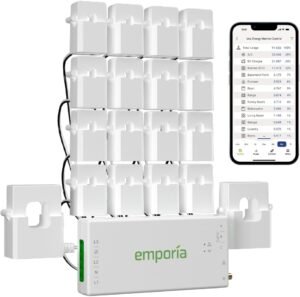
Emporia Vue 3 Home Energy Monitor &…
From the brand SAFETY YOU CAN TRUST WITH UL CERTIFICATION: With Emporia Energy, your home energy…
