

How to Choose the Right Solar Battery Capacity
Choosing the right solar battery capacity is the difference between a system that reliably covers your needs and one that leaves you in the dark during cloudy days or outages. This guide walks you through the practical steps—calculations, component matching, and real-world trade-offs—so you can size a battery that fits your usage, budget, and system design.
Throughout the article I reference categories and system components to help you pick compatible parts and packaged options from Smart World Publishing. Follow the steps below to land on a battery capacity that actually works for your home or off-grid project.
Why battery capacity matters
Battery capacity (usually quoted in amp-hours (Ah) and kilowatt-hours (kWh)) defines how much energy you can store. Oversizing adds cost and complexity; undersizing means frequent shortages. Browse the range of options to understand available capacities and chemistries: Solar Batteries.
Step 1 — Calculate your usable daily load
Start with a simple, realistic energy audit. List essential loads (fridge, lights, router, medical devices, pump) and estimate daily consumption in watt-hours (Wh): device watts × hours per day. If you have a smart meter or submetering, use those readings for accuracy—real-world data reduces guesswork: Home Energy Monitoring.
Example: fridge 120 W × 8 h = 960 Wh; lights 60 W × 5 h = 300 Wh; router 10 W × 24 h = 240 Wh; total ≈ 1,500 Wh/day.
Step 2 — Decide desired days of autonomy and depth of discharge
“Days of autonomy” is how many cloudy or low-production days your battery should cover. Typical choices: 1 day (minimal), 3 days (comfortable), 5+ days (remote/off-grid). Next, apply a usable-depth factor depending on battery chemistry. For example, lead-acid is often limited to 50% usable capacity; many modern LiFePO4 systems allow 80–90% usable.
To plan for outages and reliability, consider backup and resilience products or systems: Backup Power.
Formula: Required usable capacity (Wh) = daily load (Wh) × days of autonomy.
Then adjust for depth of discharge (DoD): Battery nominal capacity (Wh) = Required usable capacity ÷ usable DoD.
Step 3 — Choose chemistry and cycle life
Battery chemistry affects usable DoD, lifecycle, temperature tolerance, and cost. LiFePO4 (long life, high usable DoD) is common for home systems; sealed lead-acid is cheaper upfront but requires more oversizing and replacement sooner. If you prefer integrated, portable options for flexibility, consider modern packaged units as reference points: Portable Power Stations.
When comparing, look at: usable kWh (not just nominal), cycle rating at a given DoD, warranty terms, and built-in battery management (BMS).
Step 4 — Voltage, inverters, and usable power
Match battery voltage to your inverter and system design. Common nominal DC battery voltages are 12V, 24V, and 48V. Higher system voltages typically reduce cable losses and lower current for a given power, which matters for large loads and long runs.
Also check continuous and surge power requirements. If you plan to run motors, well pumps, or HVAC, ensure the inverter can deliver the required surge and continuous watts. Smart World Publishing lists inverter options that pair with battery banks: Inverters.
Step 5 — Size your solar array and charging strategy
The battery is one side of the equation; the solar array must be sized to recharge it within acceptable timeframes. Estimate daily solar energy production for your location and panel orientation. Required daily charging (Wh) = daily load + system losses (inverter, cabling) + charging headroom for autonomy recovery.
Divide required daily charging by the average effective sun-hours to get array wattage. For practical panel shopping and options in different form factors, check: Solar Panels.
Step 6 — Charge controllers and charging current
Charging rate matters. The charge controller must support the panel-to-battery charging current and the battery chemistry’s charge profile. MPPT controllers provide better harvest and faster charging than PWM. Match controller amps to panel output and battery voltage; oversizing panels is fine, but the controller and cabling must handle the current: Solar Charge Controllers.
Rule of thumb: for faster recharge after cloudy days, size panels/controller to replace most of the battery capacity in 3–6 sun-hours if budget permits.
Step 7 — Packaged systems, portability, and expansion
If you prefer pre-integrated systems (battery + inverter + charger + management) they simplify matching and installation. Portable or modular solar generators give predictable capacity and plug-and-play convenience; useful for temporary backup or small homes: EF ECOFLOW Solar Generator Delta 3 Classic (product).
For scalable residential systems, choose batteries and inverters designed to parallel or expand capacity, and verify the vendor’s recommended wiring and BMS protocols.
Installation tips and accessories
Proper installation protects battery life and performance: correct cable sizing, fused disconnects, ventilation (if applicable), and secure mounting. Use purpose-built mounting, connectors, and wiring accessories to reduce resistance and failure points; see compatible hardware and installation components: Solar Installation Accessories.
Checklist — Quick sizing summary
- Record average daily energy use in Wh.
- Decide days of autonomy (1–5+).
- Choose battery chemistry and usable DoD.
- Compute nominal battery capacity: (daily Wh × autonomy) ÷ usable DoD.
- Match battery voltage to inverter and check surge/continuous power needs.
- Size solar array: required Wh ÷ effective sun-hours; account for losses.
- Select MPPT controller sized for panel output and battery voltage.
- Plan installation accessories, wiring, and PV mounting.
FAQ
Q: How do I convert amp-hours to kilowatt-hours?
A: Multiply amp-hours (Ah) by battery nominal voltage (V) and divide by 1,000. Example: 100 Ah × 12 V = 1,200 Wh = 1.2 kWh.
Q: Should I size battery capacity for 100% DoD?
A: No. Use the recommended usable DoD for the battery chemistry to preserve cycle life—e.g., 80–90% for LiFePO4, 50% for lead-acid.
Q: Can I use a portable power station as my main home backup?
A: Small portable stations are great for short-term outages or limited loads. For whole-house or extended backup choose systems explicitly rated for that use. For portable options, compare capacity and continuous output before deciding.
Q: How much battery capacity do I need to run a refrigerator?
A: Calculate the fridge’s daily energy (average compressor run wattage × hours). Many modern fridges use 1–2 kWh/day—multiply by days of autonomy and factor DoD to size the battery.
Q: How do environmental temperatures affect battery capacity?
A: Batteries perform worse at low temperatures and may require derating or insulation/heating. Confirm manufacturer specs for low-temperature operation and built-in BMS protections.
Conclusion — Practical takeaway
Choose battery capacity by starting with your actual energy use, deciding how many days of autonomy you need, and then accounting for usable DoD and charging capability. Match voltage and inverter specs, size the solar array to recharge within your target window, and use proper controllers and accessories to protect the system. When in doubt, prioritize accurate energy monitoring and a modest safety margin—those two steps prevent most sizing mistakes.
Products Featured in This Article
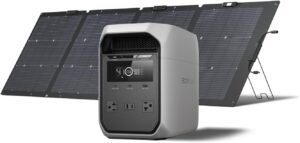
EF ECOFLOW Solar Generator Delta 3 …
From the brand Hurricane Season #TODAY Most Trusted Brand 2026 Curated Bundle DELTA Series RIVER Series…
